DharmaCode · Ancient texts + AI for a better future
Every Indian parent has a plan.Very few have a map.
Engineering. Medicine. Commerce. Find the path that fits your child's nature, and a clear plan to start on it.
- For Class 9 to 12
- Answered by you, the parent
- Report ready in minutes
- Built for the AI era
Quiz: free, no card needed · Full Report: a 20 to 30 minute parent questionnaire, ready in minutes
Inspired by the Bhagavad Gita's idea of swadharma: each person does their best work in a path that fits their own nature.
Seven archetypes. One fits your child best.
Named after figures from the Vedas, the epics and the Arthashastra. Tap any one to read how that child thinks and which careers fit.
- The BuilderVishwakarmaMakes things that did not exist before.Read more
- The HealerDhanvantariRestores what is broken in body, mind or society.Read more
- The StorytellerSaraswatiShapes how a generation sees itself.Read more
- The StrategistChanakyaSees three moves ahead and plays the long game.Read more
- The PerformerKrishnaComes alive when the room is watching.Read more
- The TraderLakshmiSpots value where others see noise.Read more
- The GuardianBheeshmaHolds the line so others can live freely.Read more
- Compare all 7 side by sideOpen the archetypes page
How it works
Take the free quiz
Ten behavioural questions, about 5 minutes. You see your child's main and secondary archetype at once.
Answer the full questionnaire
If the result rings true, a parent answers a 20 to 30 minute parent questionnaire.
Read the report
Usually ready within minutes. It opens on screen and we email you the link.
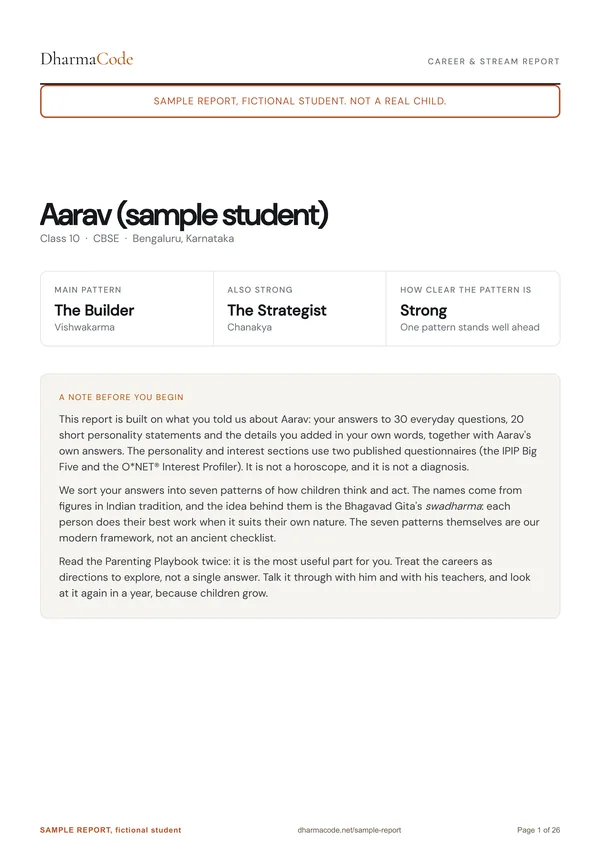
SAMPLE REPORT, fictional student
Read a full report before you pay.
Our public sample is a complete report for Aarav, a fictional student. It shows exactly what you get for your own child.
Start free. Go deeper when you're ready.
Free quiz
₹0No card needed · 5 minutes
- 10 behavioural questions about how your child actually acts
- Your child's main and secondary archetype, shown instantly
- Shareable result card for WhatsApp and Instagram
Full Report
₹999one-time
- A 20 to 30 minute parent questionnaire, plus your child's own view (optional)
- 10 ranked career paths with specific Indian colleges
- Stream and subject strategy for Class 9 to 12
- 3-month parent action plan
Report ready in minutes · Full refund if it never arrives
Built by a parent. For parents.
Every parent I speak to is asking the same question, but nobody is saying it out loud.
My daughter is 12. The questions about her future get louder every year. DharmaCode is what I built because I couldn't find this map anywhere else.
Gaurav
Questions parents ask
What is DharmaCode?
DharmaCode is a career and stream guide for families with a child in Class 9 to 12, rooted in the Bhagavad Gita's idea of swadharma: each person does their best work on a path that fits their own nature.
You start with a free 10-question quiz. If you want the full picture, a parent answers a 20 to 30 minute parent questionnaire for the Full Report (₹999) and receives a written report with ten ranked careers, Indian colleges, a subject and stream strategy, a 3-month plan and a parenting playbook.
Is DharmaCode a Hindu product?
Yes, proudly. DharmaCode is rooted in Sanatana Dharma: the Bhagavad Gita's teaching of swadharma, and figures such as Vishwakarma, Saraswati and Krishna, whose names we give to the seven patterns.
The questions themselves are about everyday behaviour, and any family who finds the framework useful is welcome to use it.
How does DharmaCode work out my child's pattern?
It adds up your answers across seven patterns: Builder, Healer, Storyteller, Strategist, Performer, Trader and Guardian. Choosing one option gives that pattern two points, choosing two options gives each one point, and saying what your child avoids takes a point away.
The two patterns with the most points become the main pattern and the one that is also strong. We describe how clearly one leads in words (strong, clear or mixed), never as a percentage. Anything you type in your own words is not scored; it goes straight to the report writer.
You also rate your child on 20 short personality statements and 24 work activities, and your child can add their own answers. A fixed table, not AI, turns those scores into the same seven patterns. When your child takes part, the Parent & child tab also shows a blended pattern where your view and theirs count half each; the written report follows your answers.
Is this a psychological or psychometric test?
Partly. The 30 everyday questions are our own behavioural questionnaire, and the seven patterns are our own modern framework, inspired by the Gita's idea of swadharma. Neither is a validated or clinical test.
The report also includes two published profiles: a Big Five personality profile from the Mini-IPIP (20 statements from the public-domain International Personality Item Pool), and a RIASEC interest profile. You answer 24 public-domain IPIP work activities (from the Oregon Vocational Interest Scales) about your child; if your child takes part, they answer the O*NET® Interest Profiler about themselves. The two use different questions, so the report shows them side by side rather than averaging them. These are not yet normed on Indian students, so we show plain scores with low, average and high bands, never percentiles, and we credit both sources in the report.
Treat the report as a structured, well-informed conversation starter. Use it alongside your child's own views and advice from their school.
Is this based on astrology?
No. Nothing in DharmaCode uses birth dates, star signs, planetary positions or any astrological data. The output is a career and stream plan built from your answers, not a horoscope.
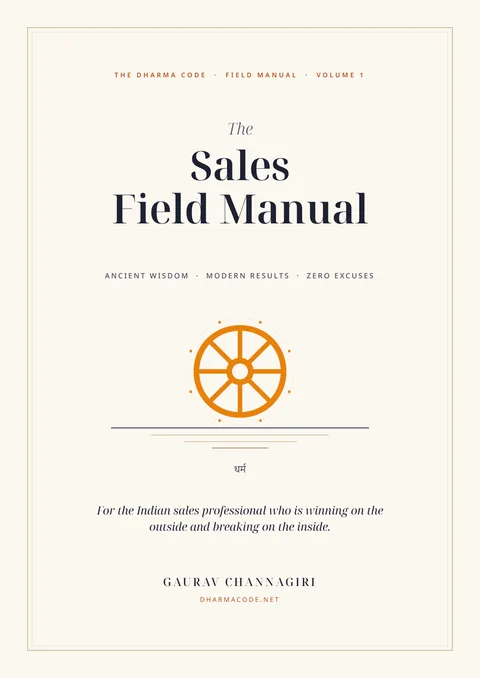
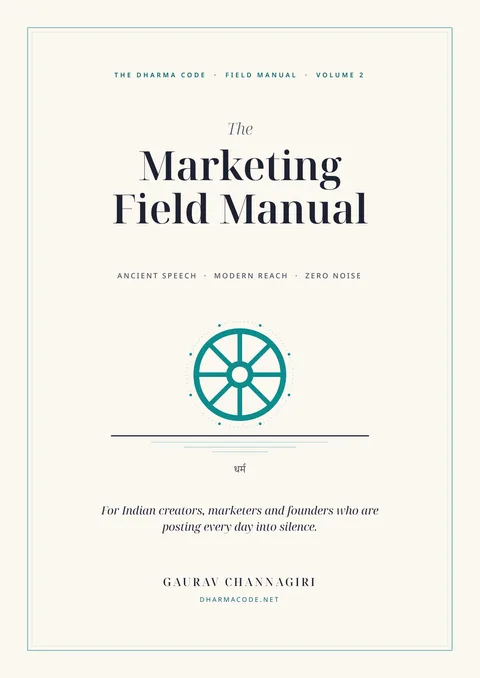
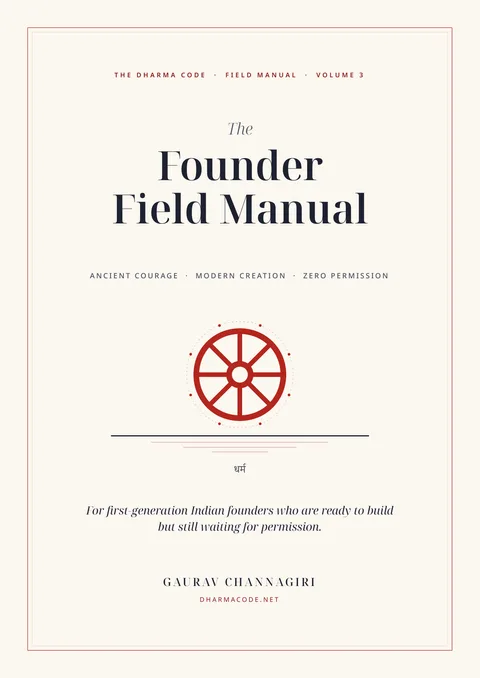
Shop the Field Manuals
For your own working life
₹299 each · all six ₹1,499